By Dr. Shaun Weng
Published June 2026
10 min read




Clinical Summary
Add paragraph text. Click “Edit Text” to update the font, size and more. To change and reuse text themes, go to Site Styles.
Content
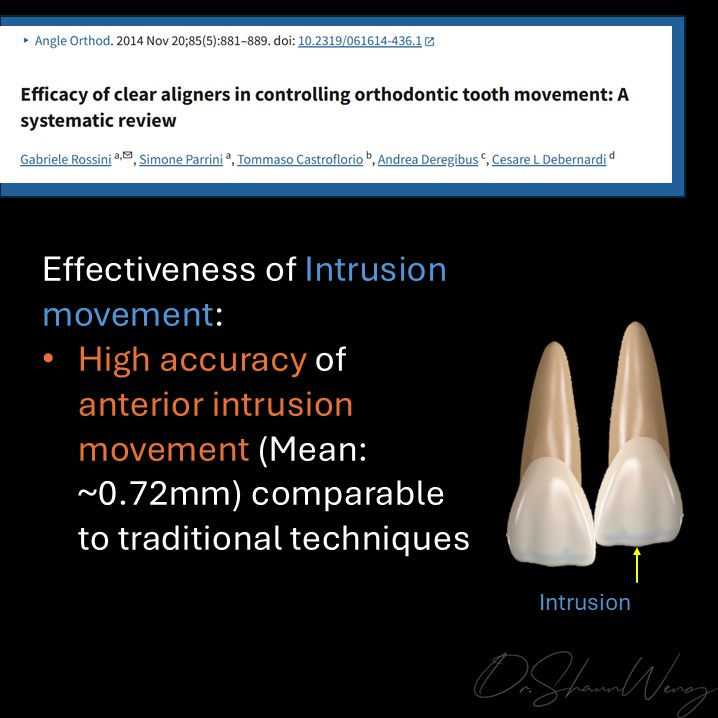
Efficacy of clear aligners in controlling orthodontic tooth movement: A
systematic review
Systematic Review by Rossini et al. in 2014 set out to
answer the following clinical research question:
"Is CAT (Clear aligner therapy) effective in controlling
the orthodontic movement in non-growing subjects?"
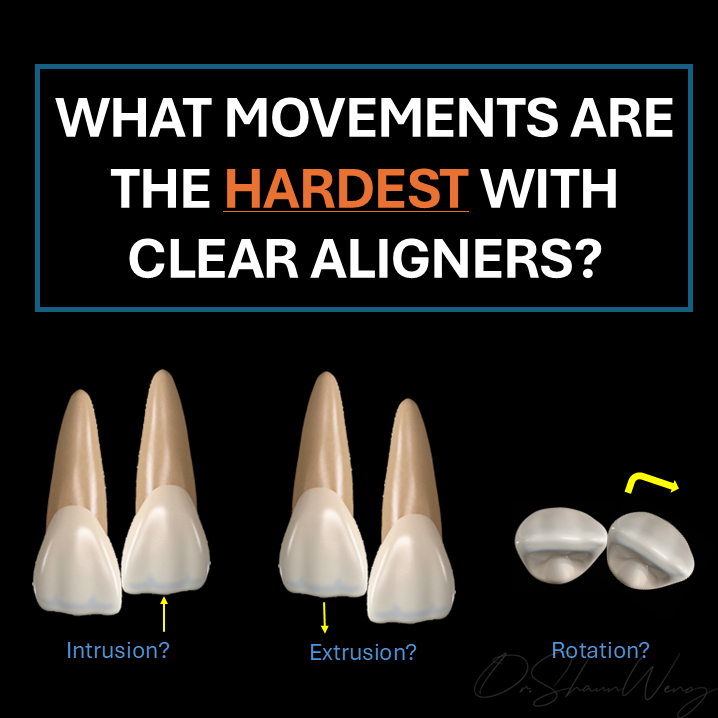
11 Relevant Publications were included in the study to determine the efficacy of CAT in performing intrusion, extrusion, rotation, tipping and alignment movements.
Effectiveness of Extrusion movements:
-Anterior Extrusive movements had the lowest predictability of 30% (average 0.56mm extrusion attempted)
Effectiveness of Intrusion movements:
-High accuracy of anterior intrusion movement (Mean: ~0.72mm) comparable to traditional techniques
Effectiveness of Bodily movements:
-Upper molar distalisation had the highest predictability of 88% when 1.5mm bodily movement was prescribed
Efficacy of Rotational movements:
-Rotational movements had low predictability especially around rounded teeth (eg. canines)
Rossini et al. recommends to consider using auxillaries (IPR, attachments, elastics, TADs etc.) to improve predictability of orthodontic movements
PROTOCOL INFORMATION
DIFFICULTY
Input text here
BIOMECHANICS
Input text here
Continue Reading
BIOMECHANICS
Premolar extraction protocols Part 2 What you may not know…

BIOMECHANICS
Premolar extraction protocols Part 1 What you may not know…

BIOMECHANICS
IPR accuracy exposed! What this study reveals may surprise you

BIOMECHANICS
Does Trimline matter in Aligners?
